MORERA Museum of Modern and Contemporary Art of Lleida
Year of Viñés
Organized jointly with the Enric Granados Municipal Auditorium
In his score, of only 152 notes, Satie stamped an intriguing and legendary indication: “To be played 840 times in a row…”. Thus, what the composer was proposing was not an ordinary piece of music, but a radical experience that, if carried out, would transform both those who played this music and those who listened to it.
Erik Satie’s Vexations is a key work in the history of music and sound art, known for its extreme repetition. The 14-hour performance imagines what would have happened if Ricard Viñes, Satie’s friend and advocate, had performed this enigmatic piece. Their friendship and collaboration were essential in popularizing Satie’s music.


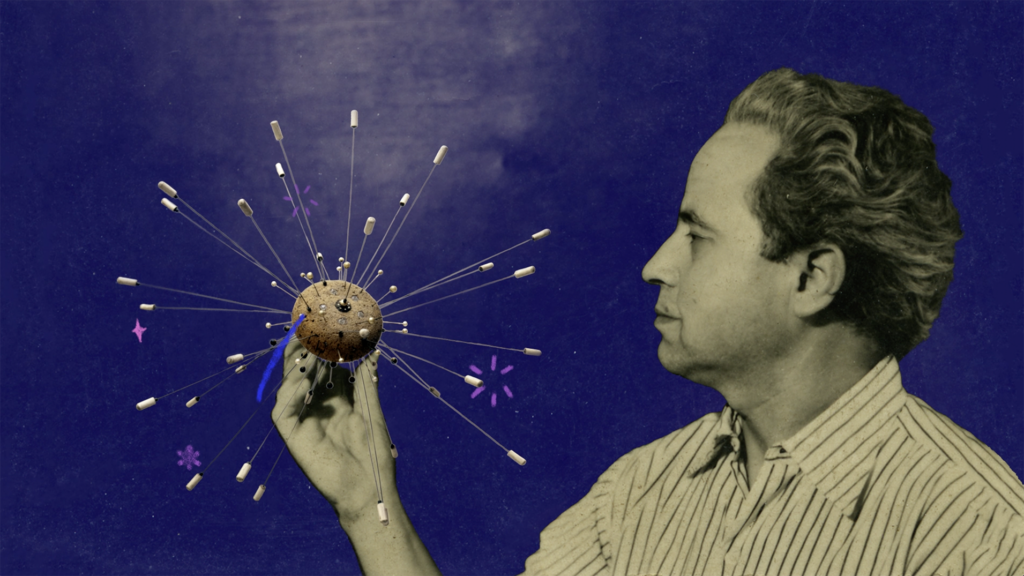
Erik Satie
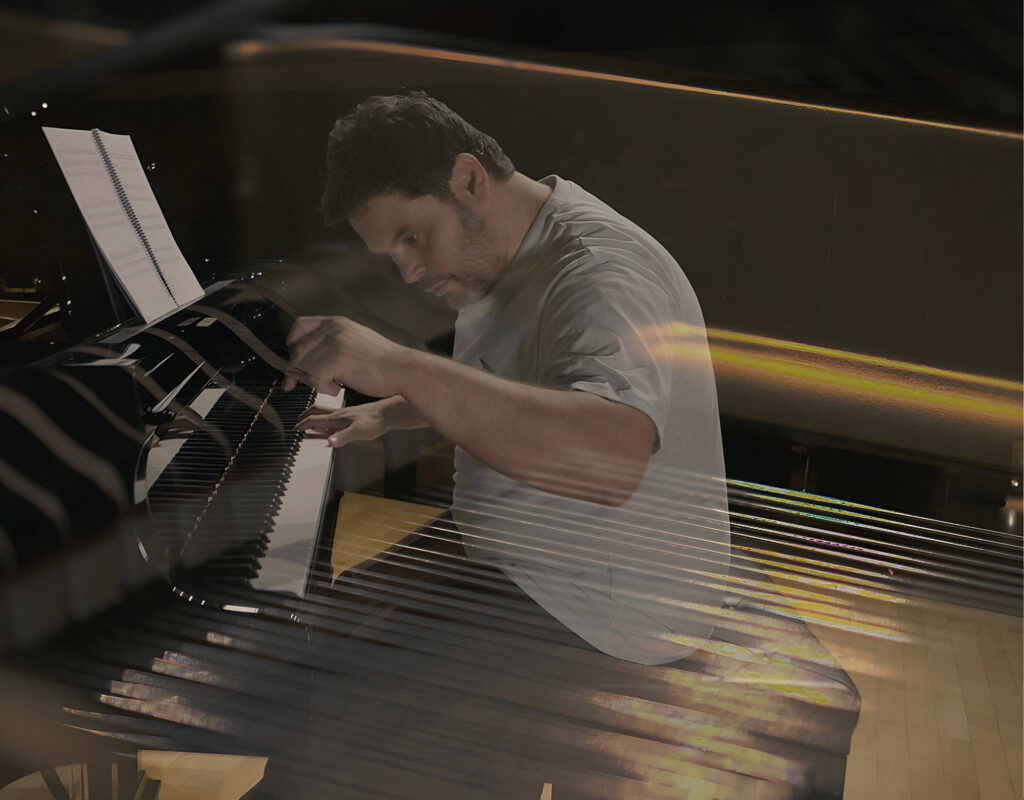
Joan Bagés performs the 840 repetitions on the piano, while the Prysma Quartet transforms the soundscape. This collective experience turns repetition into memory and resistance. It is an invitation to experience the sonic fascination that Vexations has awakened in generations of later authors, while recognizing the decisive influence of Ricard Viñes on the diffusion and musical creation of the 20th century.
Vexations is one of the most enigmatic and surprising compositions in the history of music. Written by Erik Satie around 1893, after an intense six-month relationship with the painter Suzanne Valadon, the handwritten score consists of only four bars of music and no instruments are indicated. The manuscript only contains a
The work was never published or performed in Satie’s time. It was John Cage who introduced it in 1963 in New York with a performance in which up to ten pianists participated.
This minimalist work is the first experiment in a completely erratic music, of continuous dissonance and without any directionality that explores silence, introspection, resistance, immobility and contemplation. A hypnotic experience where time ceases to exist and that borders on the state of trance. Considered for a long time as an impracticable work, very few artists dare to face alone the challenge of converting those four lines into sound.
With this initiative, the Ricard Viñes Year wants to join in the commemoration of the centenary of Satie’s death, in 1925. Satie was a composer very close to the pianist from Lleida, who was a loyal friend and was strongly involved in the premieres and dissemination of his piano work. In fact, Viñes was the trigger for Satie’s most fruitful stage. It is not a stretch to think that without Viñes’ complicity, Satie would not have managed to write a good part of his piano work.

See activity

See activity
See activity

See activity
See activity
See activity
See activity
See activity
See activity
See activity
See activity
See activity
See activity
See activity
See activity

See activity

See activity
See activity
See activity
See activity
See activity